
What Homemade Raw Actually Takes

Updated: 6 days ago
Homemade raw can be an excellent way to feed a cat, but it isn't for everyone.
I make homemade raw for my own cats because it works very well for our household. We have the freezer space, the equipment, access to the ingredients we need, and, perhaps most importantly, we've been willing to spend years learning about feline nutrition and raw feeding.
I appreciate knowing exactly what goes into my cats' food, and for us, making it ourselves is also the most cost-effective way to feed a large number of cats which unique needs (going into heat, pregnancy, lactation, young kittens).
But when people ask me about feeding raw, I don't want to give the impression that homemade raw is simply buy some meat, grind it up, and put it in a bowl! It isn't!
A homemade diet comes with responsibility. You're taking on the job that a commercial pet food company would otherwise be doing: sourcing ingredients, creating a nutritionally complete diet, preparing it safely, storing it properly, and making sure your cat receives what they need day after day.
That can be incredibly rewarding- but it is also a commitment.

Before You Decide to Make Your Own Food
There is a difference between wanting to feed raw and wanting to make raw food yourself.
If you like the idea of feeding raw but don't want to spend your time sourcing organs, grinding meat, measuring supplements, portioning food, cleaning equipment, and managing a freezer full of cat food, that's completely okay!! You're not out of luck because premade raw exists for a reason and has become so much more available in the recent years especially.
Homemade raw makes the most sense for someone who genuinely wants to take on the process and is willing to learn enough to do it responsibly. So before you start buying equipment, ask yourself whether you're actually prepared for the commitment. Hopefully this resource will also help you make that decision!
Freezer Space
This is one of the things people don't always think about.

Raw food takes up space, and homemade food is generally made in batches rather than one meal at a time. Going that route means you'll need somewhere to store your finished food, and you'll probably want enough room to purchase ingredients in reasonable quantities as well.
The more cats you have, the more significant this becomes.
For one cat, freezer management may be fairly simple. For a multi-cat household, you're suddenly storing pounds and pounds of frozen meat and prepared food.
And if you are making food for several cats, you don't want your entire freezer situation to depend on having just enough room for the batch you made yesterday. We have THREE full sized chest freezers AND a full size Fridge/Freezer combo dedicated for the cats. But we have a lot of cats and we like to make huge batches to avoid having to be making food every weekend.
So likewise, unless you want to be making their food weekly (which you probably don't!), you'll want ample space.
Time
Homemade raw takes time.
There is the time spent finding and purchasing ingredients, which can be more involved than simply making a grocery-store shopping list.
Then there is the actual preparation: weighing ingredients, trimming and processing meat, grinding when appropriate, measuring supplements, mixing everything thoroughly, portioning it, packaging it, getting it into the freezer, and cleaning up.
This isn't necessarily an every-day chore. Many people, including us, make larger batches and freeze them, which makes the daily feeding itself very easy.
But the preparation day is still real work! When we have kittens, we make raw food almost every other week because they eat so much! But when we dont, we can make it every other month and not have to worry about it. This is going to be decided ultimately by the amount of freezer space you have.
If you are someone who already has a packed schedule and you're going to resent spending part of your weekend making cat food, homemade raw may not be the best choice for you.
The best feeding system is one you can actually maintain.
Equipment Needed
Depending on how you formulate your diet, a good meat grinder can be an important piece of equipment.
This is not a job for a little countertop food processor. You're potentially processing substantial quantities of meat and, depending on the approach you're using, bones or other ingredients that require appropriate equipment.
A grinder is also something you need to clean thoroughly and maintain.
It's another expense and another piece of equipment taking up space in your kitchen or food-preparation area.
If you're someone who already loved casing sausage and has a grinder- more power to you! But most families aren't prepared for having to grind up bones!
If the thought of buying, using, cleaning, and storing a meat grinder makes you want to give up before you start, that's probably useful information.
Finding the Ingredients
One of the biggest differences between homemade raw and conventional pet food is ingredient sourcing.
You aren't simply buying a package that already contains everything your cat needs.
Depending on the diet you're making, you may need different types of muscle meat, liver, other organs, specific supplements, and other ingredients that aren't always available at your local grocery store.
Some ingredients can be surprisingly difficult to find consistently locally.
You may need to visit different stores, find a specialty supplier, order ingredients, buy in bulk, or plan ahead around what's available.
This becomes particularly important if you're feeding multiple cats or have a specific formulation you rely on.
You don't want to discover that you're out of an important ingredient when you need to make your next batch!
For us, we have a local farmer just north of us and we buy in large batch quantities and even then, if they can't provide us with enough hearts or tripe, I need to source those elsewhere! There are definitely great places that ship too though (like Raw Feeding Miami), so this doesn't have to be a huge obstacle- just something to be aware of.

Nutrition Responsibility
This is the part I think deserves the most respect.
Homemade raw is not nutritionally complete simply because it contains a variety of raw meats.
Cats have specific nutritional requirements, and a complete diet needs to provide those nutrients in appropriate amounts and proportions.
That's why a homemade raw diet can involve much more than muscle meat. Depending on the formulation, you'll need to consider things such as organs, calcium or bone, essential fatty acids, amino acids, vitamins, and minerals.
This is especially important when feeding very young kittens, pregnant cats, nursing mothers, or cats with particular nutritional needs (which might not affect you as much as it affects me, but maybe!).
You are responsible for what goes into that bowl.
That doesn't mean you need a degree in animal nutrition to feed homemade raw. It does mean you should be willing to learn what you're doing rather than blindly putting meats in a bowl or following a generic google recipe without any double checking or research.
Don't Be Afraid to Learn
This is probably my biggest piece of advice for anyone considering homemade raw:
Don't stop learning just because you've found a recipe you like.
Raw feeding is a subject worth being curious about.
Learn what the different ingredients contribute. Learn why certain nutrients matter. Understand what happens when you substitute one ingredient for another. Learn about food handling and sanitation. Read different perspectives and look at research.
And if something doesn't make sense, look it up.
I don't think you should feel like you have to become a feline nutrition expert before you can make cat food. But I do think you should understand enough about the diet you're making that you can recognize when something doesn't add up. A recipe can be a starting point, but shouldn't be a substitute for understanding.
You Also Have to Be Consistent
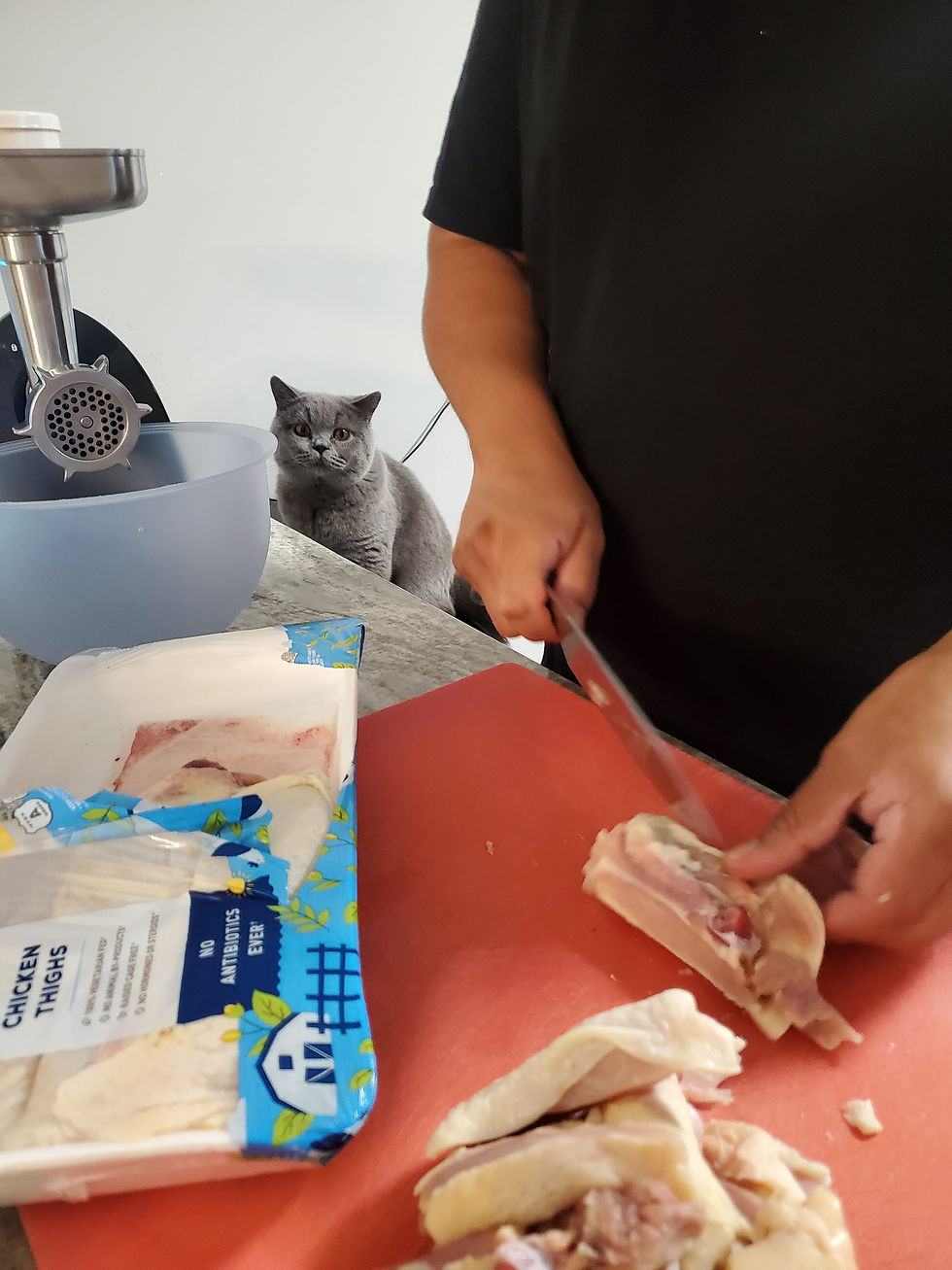
Your cat doesn't get to take a vacation from eating a complete diet because you got busy this week.
Once you've committed to homemade food, you need a system that allows you to keep making it.
That means planning ahead!
If you know you're going to be traveling, you'll need to think about what your cats are going to eat while you're gone. If someone else is caring for them, they'll need clear instructions for storing and feeding the food.
You may need to prepare enough food before a trip, make arrangements for frozen storage, or have a backup feeding option available.
This is one reason freeze-dried raw or a good premade raw food can be incredibly useful even for someone who normally makes their own food.
Homemade raw doesn't have to be your only tool.
Traveling Is a Good Reality Check
If you're considering homemade raw, think honestly about your lifestyle.
What happens when you go on vacation?
What happens when your cat needs to stay with someone else?
What will you do when your grinder overheats and stops working mid-batch (been there!)
What happens when you have an unusually busy month at work?
What happens if you have a power outage affecting your freezers? (been there too!!)
What happens when the ingredients you normally use aren't available?
Having a plan for those situations is part of feeding responsibly.
For our own cats, we've built systems around the fact that raw is their normal diet. But I also don't think there's anything wrong with having practical alternatives for situations where homemade food simply isn't convenient.
The goal is to feed your cat well- not to prove that you can make every meal yourself under every possible circumstance.
Food Safety
Whenever you're handling raw meat, you need to take food safety seriously.
That means keeping raw ingredients appropriately refrigerated or frozen, cleaning preparation surfaces and equipment thoroughly after making food and after serving it daily, washing your hands, preventing cross-contamination, and storing finished food properly.
Good sanitation habits are simply part of the job.
As a family of 6, this is especially high on our list of concerns because we need to make sure the children are very aware of the risks of being in contact with the raw food when we're making it or serving it. Likewise, for children too young to have clear understanding of food handling safety, you'll want to plan to feed kitty in a place that will keep little hands safe.
Is Homemade Raw Worth It?

For us, absolutely.
I like the control it gives me over ingredients, seeing the quality of health in my cats, and feeding a large number of cats makes homemade food particularly practical for our household.
But I don't recommend homemade raw to everyone.
In fact, I think premade raw is a better choice for many families who want to feed raw.
You can still feed a raw diet without taking on all of the responsibility of sourcing, grinding, formulating, supplementing, and preparing the food yourself.
And that's an important distinction.
You don't get extra points for making the food yourself.
If premade raw means you can consistently provide a complete raw diet without turning feeding your cat into a stressful chore, that's a perfectly good choice.
A Quick Reality Check
Before committing to homemade raw, ask yourself:
Do I have enough freezer space?
Do I have the time to make food regularly?
Am I comfortable handling raw meat? Including liver, hearts, and maybe other unusual things?
Am I willing to purchase and maintain the necessary equipment?
Can I reliably source the ingredients I need?
Am I willing to learn about feline nutrition rather than simply following a recipe?
Am I comfortable taking responsibility for making sure the diet is complete?
Do I have a system for preparation, portioning, and storage?
Am I prepared to handle raw meat safely?
What will I feed my cats when I'm traveling?
Do I have a backup plan for emergencies or unexpected circumstances?
Can I realistically keep doing this six months from now? Five years from now?
If the answer to those questions is yes, homemade raw may be a great fit for you!
If several answers are no, that doesn't mean raw feeding isn't an option.
It may simply mean that premade raw or another high-quality, moisture-rich food is a better fit for your life.
Final Thoughts
I believe homemade raw can be an excellent way to feed a cat. But I also believe we should be honest about what it requires.
It takes time.
It takes space.
It takes equipment.
It takes planning.
It takes learning.
And it takes responsibility.
If you're willing to take those things on, making your cat's food can be incredibly rewarding.
If you're not, there is absolutely no shame in choosing a premade raw diet instead.
Feed the best diet you can realistically and consistently provide- and understand what you're putting in your cat's bowl.
Disclaimer: This information is for educational purposes only and is not veterinary or nutritional advice; you are responsible for decisions regarding your cat's diet and care.

Comments